Monday, December 26, 2011

USGA, R&A Announce New Rules For 2012


In case you missed the news earlier this fall, the USGA and R&A announced the amendments to nine principal rules. This is the first time both the USGA and R&A have worked together to change golf's rules. The rules, which take effect January 1, 2012, have been published in the new Rules of Golf for 2012-2015. In no particular order, here are the three major amendments that have been made:
  • Ball Moving After Address (Rule 18-2b). A new exception is added which exonerates the player from penalty if their ball moves after it has been addressed when it is known or virtually certain that they did not cause the ball to move. For example, if it is a gust of wind that moves the ball after it has been addressed, there is no penalty and the ball is played from its new position.
  • Ball in Hazard; Prohibited Actions (Rule 13-4). Exception 2 to this Rule is amended to permit a player to smooth sand or soil in a hazard at any time, including before playing from that hazard, provided it is for the sole purpose of caring for the course and Rule 13-2 (improving lie, area of intended stance or swing or line of play) is not breached.
  • Time of Starting (Rule 6-3a). The rule is amended to provide that the penalty for starting late, but within five minutes of the starting time, is reduced from disqualification to loss of the first hole in match play or two strokes at the first hole in stroke play. Previously this penalty reduction could be introduced as a condition of competition.
The most significant change (Rule 18-2b) will see an end to situations like the one witnessed during the final round of this year’s Open Championship when Northern Ireland’s Rory McIlroy was penalised when his ball was moved on the seventh green by the wind after he had addressed it.

Padraig Harrington, three-time Major winner and R&A-Working for Golf Ambassador, said: “I am delighted with the changes, in particular the ball moving after address. Every time the wind blows I am worried that my ball is going to move and I am worried about grounding my putter, distracting me from trying to hole my putt.

“This change will speed up play, there won’t be as many suspensions and players won’t be getting penalised or disqualified unfairly. It is definitely giving us players a little bit of a break.”

If you are interested in learning more about the rule changes, the Golf Channel will be airing a 30-minute special called "New Year, New Rules" on December 31st at 11:30pm EST. The show will then re-air every half hour from 6am - 7:30am EST on January 1st.

Wednesday, December 21, 2011

The Greatest Round Ever Played?


As golfers, we all know that it is quite a feat to shoot one's age. So, imagine how spectacular of day the late Kim Jong-Il had back in 1994. It is reported that the North Korean dictator, age 52 at the time, carded an epic 38-under par (34) on the 7,700 yard Pyongyang Golf Course.

According to some reports, Kim's round included a world record 11 holes-in-one and he carded no worse than a birdie on any hole at the country's only golf club! This amazing feat also happened on what was his first ever round of golf. And even though all 17 of his bodyguards were eyewitnesses and swear they saw that go down, for some reason, the folks over at "Guinness" fail to recognize the record. After that round, the media tells us, Kim decided to retire from golf forever, lest he ruin it for us mortals.

The odds of making a hole in one for the average golfer is 12,500 to 1, so can you imagine what the odds are of making 11 hole-in-ones in one round? Well, thanks to the Postmedia News, now we know:

According to the Wall Street Journal, a Palm Springs, California, statistician recently calculated that the odds of a 46-year-old woman, Jacqueline Gagne of Rancho Mirage, California, making 10 holes-in-one in less than four months - a claim apparently verified by the Desert Sun newspaper - at roughly 12 septillion (12 followed by 24 zeros) to 1.

Making 11 aces in the same, first, and one and only, round of golf would be, according to Postmedia News' calculation, 183 gazillion to 1.


It's probably a good thing for Tiger Woods and the rest of the PGA Tour that Kim spent his time ruling his people because clearly he could have ruled the Tour as well.

Wednesday, December 7, 2011

Time for Training!

One of the most important parts of the off-season for us is to train our staff for the upcoming season.  Today, key staff from every facility are at Rattlewood Golf Course attending an AED/CPR training class.  Each one of our facilities is equipped with an Automated External Defibrillator in the event that a golfer or an employee is suffering from cardiac arrest.

In fact, last year one of these life-saving devices was successfully used at Poolesville due to the quick and methodical action taken by superintendent Dan Hofmeister, and there were 8 other lives saved on golf courses in Maryland last year with the use of an AED.
During the 3 hour training session today, every person was certified in proper CPR and AED procedures.  MCRA remains committed to having a top notch staff at every facility!
Throughout the winter, general managers and professional staff will undergo intensive training every week on topics such as:
  • Golf Instruction
  • Customer Service
  • Business Management
  • Merchandising
  • Staff training
  • Food & Beverage Management
  • Operational Efficiencies
  • and many more!
Our superintendents will also spend a significant amount of time training in-house on topics such as:
  • Environmental Programs
  • Safety
  • Turf Technology
  • Research
  • Course conditioning
  • Irrigation Management
  • Pest Management
  • and other topics
They will also attend local and national turfgrass management conferences to stay up to date on the the latest in agronomic research, turf disease and water management, cost savings measures, regulatory and compliance education, as well as a host of other timely topics.

So, in addition to keeping up with dozens of winter projects at every facility, winter time does not constitute "down time" as many people think.  We are vigorously preparing for another great season at Montgomery County Golf!

Monday, December 5, 2011

Golf 101: Terminology


After I was finished giving rules and format announcements to our Frostbite Open participants this weekend, I realized that I was using some terms that not every golfer quite understands. Although some of these terms seem very basic to some of us, I thought I would go through and give a brief definition of twenty-five of the more commonly used golf terms. If there is a term that you don't understand that isn't listed below, please let me know and I will try and give you a good definition and understanding of it.

1. BACK NINE: The back nine consists of the last nine holes of a golf course.

2. BIRDIE: A birdie occurs when you finish any hole one shot below the par rating for that hole. For example, if you are on par 5 and you only take 4 shots to get your ball in the hole, then you have scored a birdie on that hole.

3. BOGEY: A bogey is the opposite of a birdie. A bogey occurs when you hit the ball into the hole using one more strike than par. So if you are on par 5 and you take 6 shots to get your golf ball in the hole, then you have scored a bogey.

4. CUP: The cup is simply another word the hole in the green which is the ultimate target for the golf ball.

5. DIVOT: A divot is a small piece of turf which is removed by your golf club when you hit a ball. Divots should be repaired (replaced) as a matter of basic golf course etiquette.

6. DRAW: A draw describes a shot which bends to the left (for right handed golfers).

7. FADE: A fade is a shot which sends the ball veering slightly to the right (for right-handed golfers).

8. FAIRWAY: The fairway is the playing area between the tee and the green. This does not include hazards.

9. FLAGSTICK: A flagstick is a movable marker that shows the location of the hole.

10. FRONT NINE: Front nine referes to the first nine holes of a golf course.

11. GREEN: The green area is a closely mowed area on which the hole is situated. It is also referred to as the putting surface.

12. HANDICAP: A handicap is a system of adjustment to the score system so that golfers of different skill levels can compete with one another without the better players dominating the game.

13. HONOR: To be 'given the honor' is to be granted the privilege of playing first within your group. Typically this is achieved by scoring the lowest of the group on the previous hole.

14. HAZARD: A hazard is a bunker, sand trap or water on the golf course that may cause golfers difficulty.

15. IMPEDIMENT: An impediment is loose debris around the ball which is obstructing your shot and which can be moved away from your ball.

16. LATERAL WATER HAZARD: A lateral water hazard is a water hazard or that portion of a water hazard which is situated so that it is impossible, or impracticable, to drop a ball behind the water hazard. All of the ground and water within the margin of a lateral water hazard are considered to be part of the lateral water hazard.

17. MATCH PLAY: Match play is a type of competition in which each hole is a separate game. The winner of a match play game is whoever wins the most holes.

18. NUKED SHOT: A nuked shot is a shot which is hit far harder and longer than you would normally hit the ball with a particular club.

19. OB: OB stands for out-of-bounds. This is the area which is outside of the course and which is often marked with white stakes. The ball should not be played from this area.

20. PAR: One of the most basic golf terms, a par is the number of strokes assigned to each hole. This can range from anywhere between 3 to 6 strokes.

21. ROUGH: According to golf language, the rough refers to the high grassy area close to the fairway and green.

22. STROKE: A stroke is contact, or an attempt at contact, with the golf ball. A stroke is the forward movement of a golf club that aims to hit the golf ball.

23. STROKE PLAY: Stroke play is a competition that is based upon the number of strokes each golfer takes for a given round.

24. THROUGH THE GREEN: Through the green refers to the whole area of the course except for the teeing ground, the putting green of the hole being played and any hazard areas.

25. WATER HAZARD: A water hazard is any sea, lake, pond, river, ditch, surface drainage ditch or other open water course (whether or not it contains water) and anything of a similar nature on the course.

Obviously there are many more, but hopefully this may help a few of you "Talk the Talk"!

If you are new to the game or know someone who is new to the game, MCG also offers a great instructional program for beginners called "Get Golf Ready". The Get Golf Ready Program is designed to teach you, in five short lessons, everything you'll need to know to step onto a golf course and get out to play with confidence, including terminology. Get Golf Ready is taught by trained PGA and LPGA Professionals who will make sure you have fun each step of the way. For more information, visit our website at www.montgomerycountygolf.com.

Matt Jarvis
General Manager
Poolesville Golf Course

Thursday, December 1, 2011

Laytonsville #3 green drainage project

For any of you who have played Laytonsville after it has rained, you no doubt have experienced how wet and spongy #3 green is.  Superintendent Galen Evans and his great team have recently undertaken a major renovation to this green to help solve the drainage problem that existed.

As you can see from the above photo, there is a distinct layer that exists from when the green was constructed nearly 40 years ago.  This layer is the primary cause of the lack of water infiltration into the green.  You can also see throughout the profile numerous sand channels that are the result of core aeration.  In this green, however, continued aeration is just not enough to ameliorate the significant layering problem, and it was time for more drastic measures.
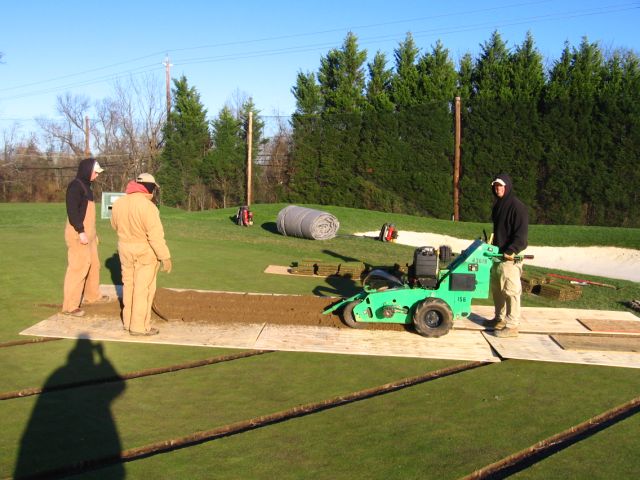
  After sod was stripped for the trencher, drain lines were carefully excavated, making sure spoils stayed on plywood to keep the surface of the green clean.
 2-inch drain pipe was installed after the proper slope was achieved at the bottom of the trenches....
 and the greens mix was added and tamped back into place...
Finally the pieces of sod were placed back in the exact order they were removed. Once the green is completely cleaned off of debris, it was rolled repeatedly to return the surface to its original condition for playability.


Drains were installed every 6 feet, about 18 inches deep across the green and back-filled with a mixture of 60% sand, 20% peat and 20% topsoil.  This mixture is a good recipe for allowing water to percolate down to the drain lines, and also having the ability to hold enough water and nutrients to maintain healthy turf.

Jon Lobenstine
Director of Agronomy

Getting ready for the off-season

While the golf season is winding down, our golf maintenance teams are just as busy as ever!  The off-season provides unique opportunities for us to take on projects that can't be completed when we are hard at work keeping up with daily routine mowing and course preparation tasks.  But now that turf growth has slowed considerably, there is time to begin much-needed work on rebuilding bunkers, installing drainage, upgrading irrigation system capabilities and performance, doing tree work, and developing a prioritized game plan for other winter work. 


We will continue to update this blog with examples of important winter projects that are going on that will ultimately improve your golfing experience at our facilities!

Jon Lobenstine
MCG Director of Agronomy